STELLA Workspace. Generative molecular design for medicinal chemists.
Prediction is not a decision.
You were given a number. You still had to decide what to make.
AI tools predict more than ever, and the models keep getting better. A number still cannot tell you whether to synthesize. STELLA sets every candidate against a reference compound you already know, so you can see how far it moved and why. The call stays yours, every round of the DMTA loop.
You already do this by hand.
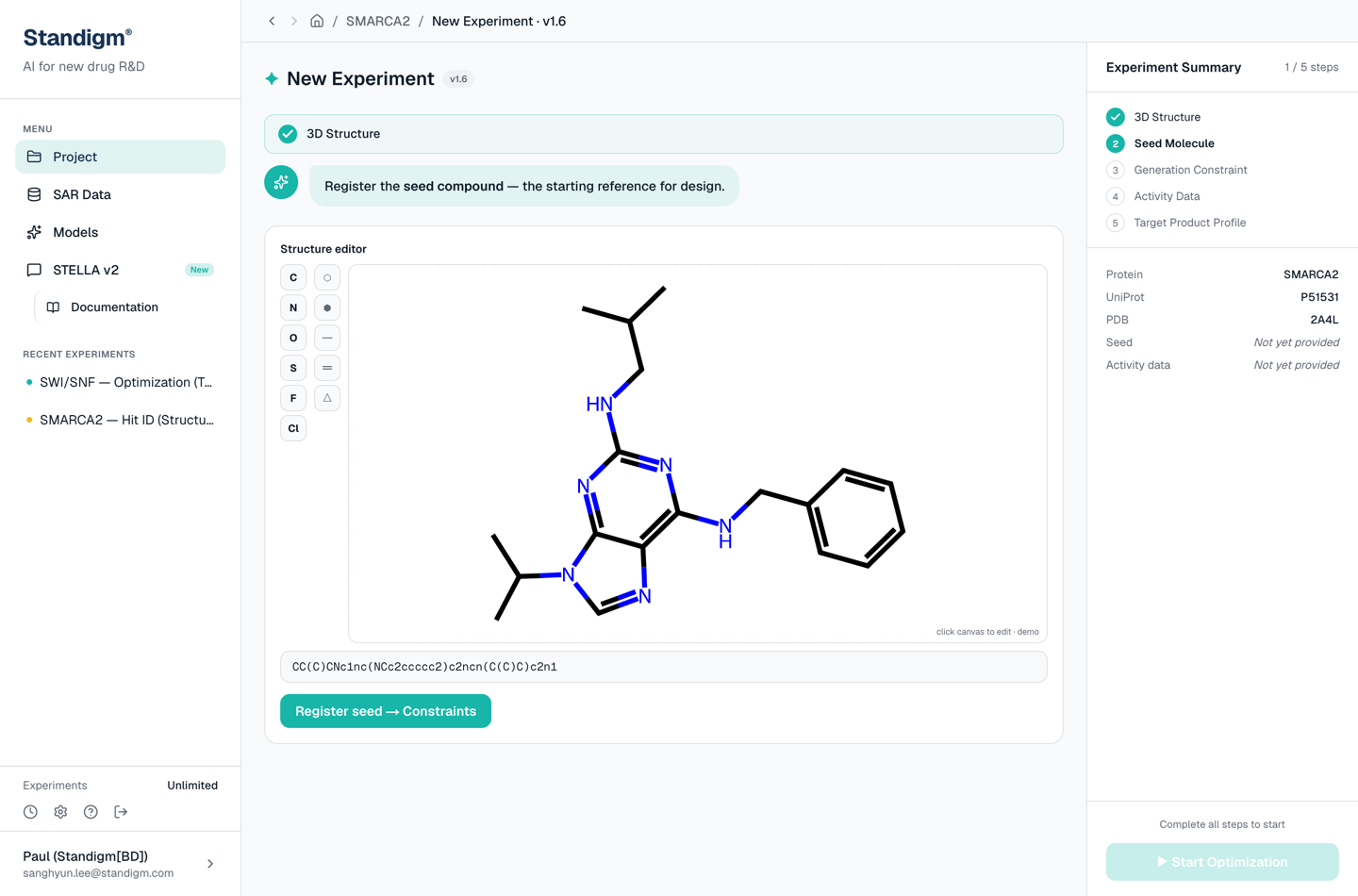
Take the compound your series is on. Keep the scaffolds you care about, vary the groups around them, and see what should bind better.
STELLA does the same, over hundreds of analogues at once.
How it Works
Go far from your reference, one step you can read at a time.
A few hundred optimized molecules handed over at once is past what anyone can weigh. Without seeing how far a structure sits from the one you know, there is nothing to decide on.
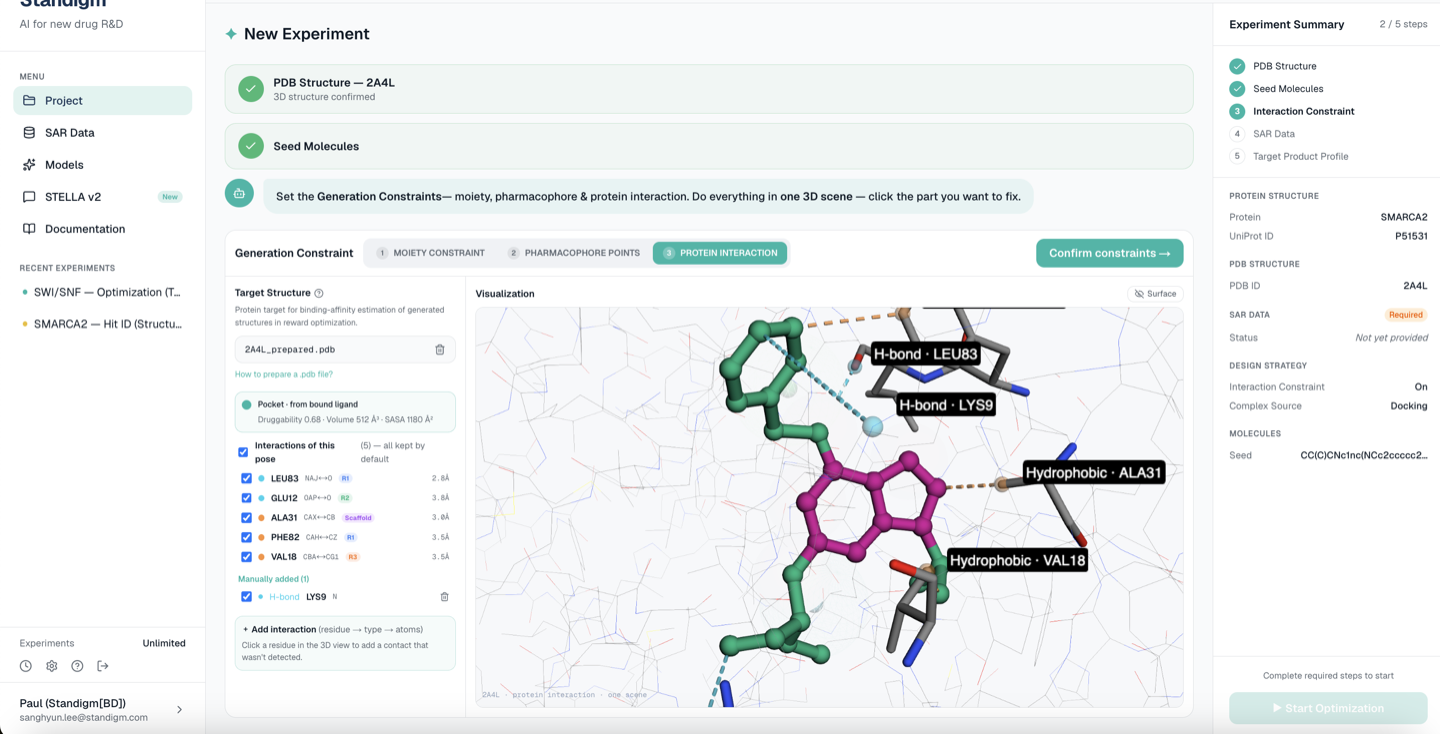
So STELLA runs the DMTA cycle you already work in. Each episode moves one interpretable step, and every design stays structurally comparable to your reference, with predictions underneath as supporting evidence. Ten episodes on, the molecule may look nothing like where you started. It never arrived as a leap. You can trace every decision that got it there.
A white box you can read all the way through. The number narrows the field; you decide what gets made.
Choose your objectives
Activity is already on, and the rest of the TPP (CYP, LMS, PPB, Solubility, Permeability, hERG) stays optional. Click Activity and the tree opens: pick structure-based, which scores on the 3D protein structure, or ligand-based, which scores from ligand data or the sequence with no 3D structure required. You can take both.
Results
You get results every episode, while the run can still change
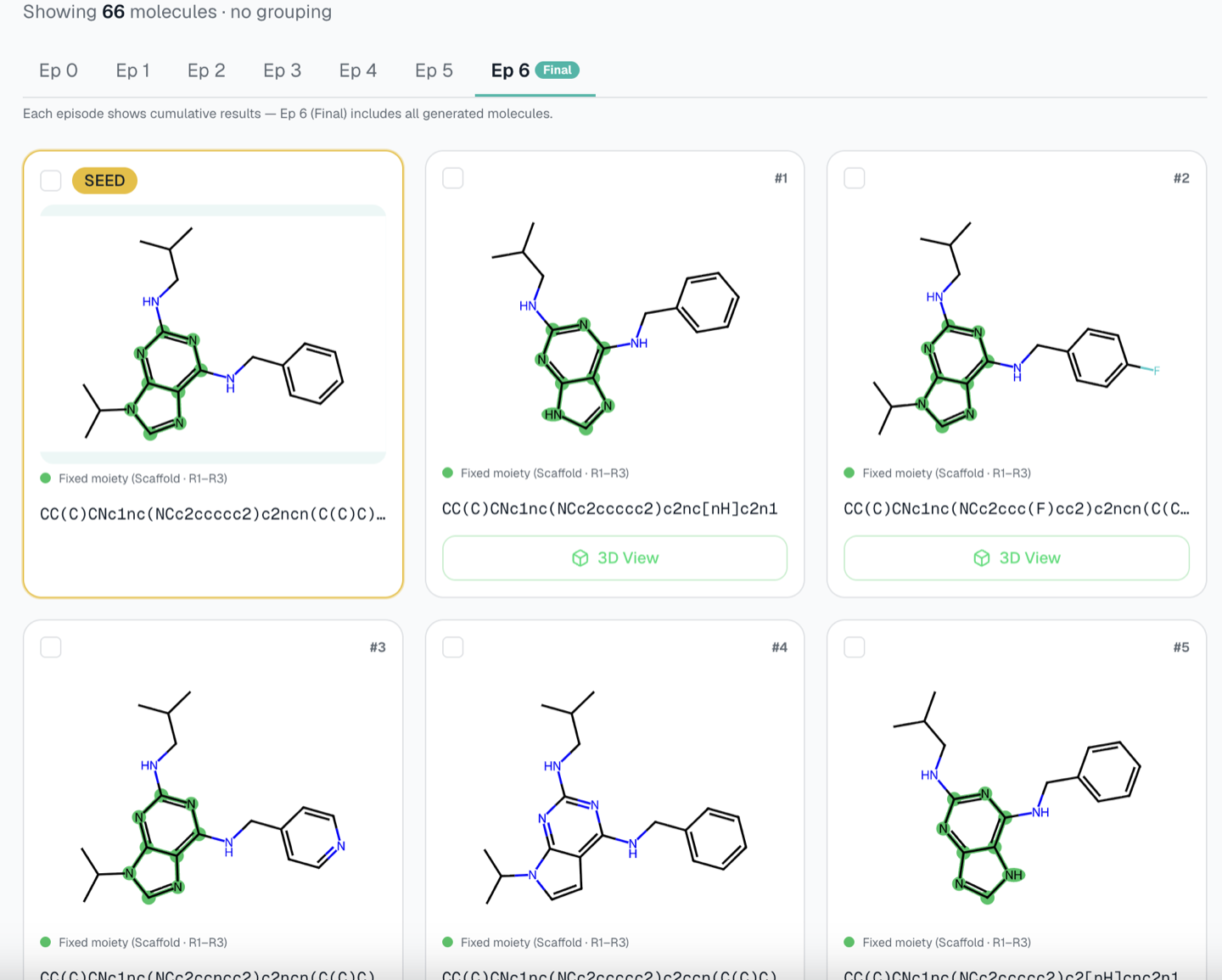
Every episode returns a fresh set, gathered by STELLA Score and sorted by activity. Read it structure-first against the compound you already know, pick what's worth pursuing, and your feedback grows your design strategy for the next episode.
Candidate grid
Candidates that clear your STELLA Score threshold are gathered first, then sorted by activity. You read each one structure-first against the reference you already know, then feed back what is worth pursuing. Your call shapes the next episode.
Episode improvement
Watch the STELLA Score climb episode over episode as the DMTA loop runs.
Compare in 3D
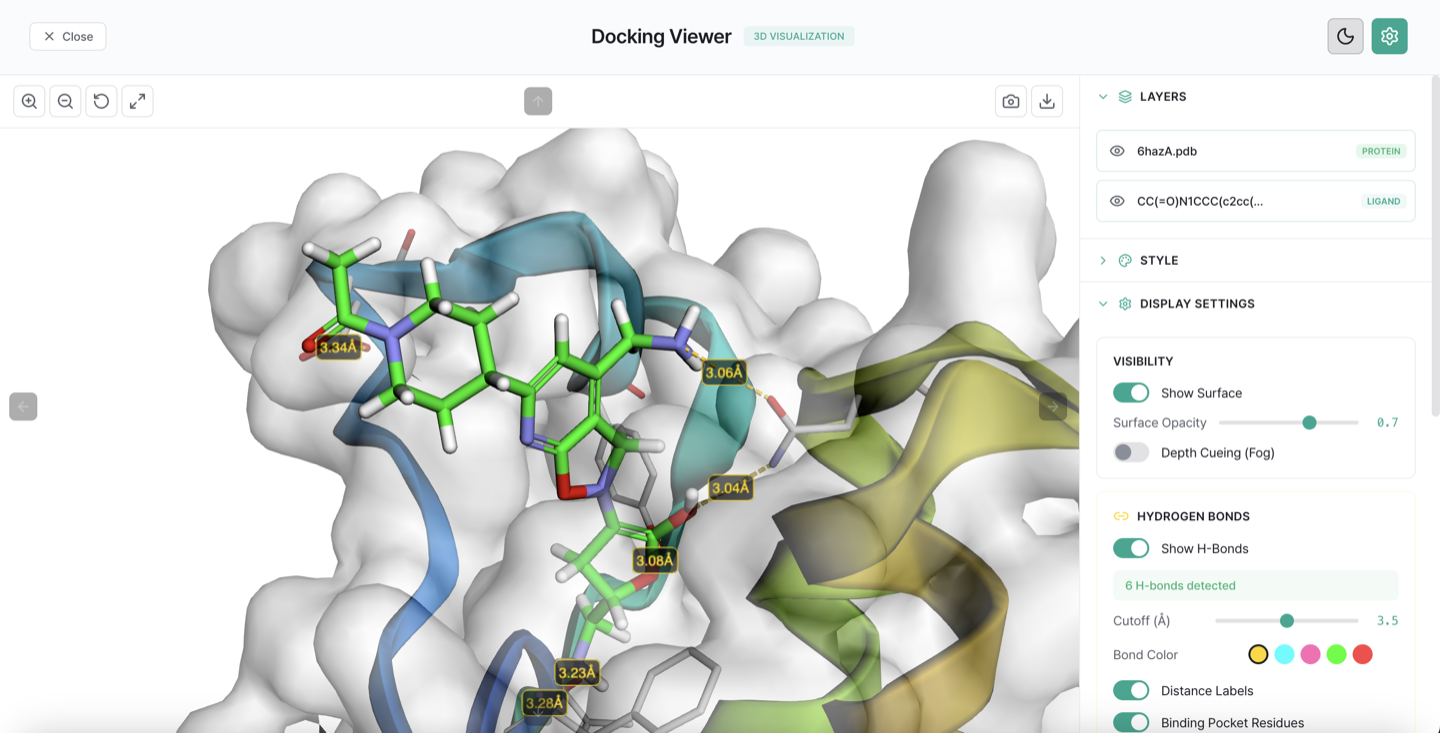
Hit 3D View on any molecule to overlay it with your seed and inspect the pose in 3D.
Export to Excel
Take your selected candidates out for the next round of review.
DMTA loop
A DMTA loop you steer, round after round
A loop is only yours if you can reach into it: while it runs, in what it scores on, and before it even starts. Most tools give you none of the three.
You can tell the run is drifting, but only after it has finished.
You correct it mid-run
Your feedback each episode becomes the constraint on the next, so every round follows the chemistry you are steering toward. With most generators, stopping the run is the only control you have.
A generic score can't tell your series apart from anyone else's.
Sharper on your series
Bring your SAR and assay results in, and STELLA fits the model to your series and TPP. Scoring stops being generic, and sharpens with your data as the program runs.
The design was ready long before the input deck was.
Nothing to prepare
No SDF, no input deck, no ticket to CADD. Draw it like you would on a whiteboard. Upload a PDB, or let STELLA find the structure for you.
WHY STELLA
Built for Medicinal Chemists
See how STELLA Workspace compares from a medicinal chemist's perspective.
| Criteria | STELLA Workspace | Company A | Company B | Company C |
|---|---|---|---|---|
| Annual Price | $25,000/yr | $100,000+/yr | $95,000/yr | $75,000/yr |
| Primary User Focus | Medicinal Chemist-centric | Comp Chem-centric | AI/Model-centric | Structure exploration |
| Usable without CADD Knowledge | Yes (no learning curve) | Difficult | Partial | Partial |
| Iterative Design Structure | Step-based iteration | None | None | None |
| Molecule Selection → Next Step | Auto-connected workflow | Parameter setup required | Model-driven execution | Simple generation |
| SAR/PDB Input Simplification | LLM-assisted data prep | Manual curation | Limited | Limited |
| Project Context Accumulation | Decision history tracking | None | Limited | None |
| Ease of Use (Med Chem) | Low barrier | High barrier | Medium | Medium |
PRICING
Simple, Transparent Pricing
Purchase tokens to run experiments in parallel. More tokens = faster iteration cycles.
1 token
- Scaffold-locked Generation
- Automated Binding Mode Analysis
- Multi-parameter Scoring
- 3D Pose Visualization
- Molecule Library
- Project History
2 tokens
$2,250 per token
- Scaffold-locked Generation
- Automated Binding Mode Analysis
- Multi-parameter Scoring
- 3D Pose Visualization
- Molecule Library
- Project History
- Up to 2 parallel tasks
All plans include standard features. Need a custom plan? Request a demo
Generative, docking, MPO scoring, ADMET, QSAR. One workflow.
Bring one target and one reference compound.
Contact: business@standigm.com